
Emergency Air Duct Cleaning Near Me: What New York City Homeowners Should Do First
If you’re searching “emergency air duct cleaning near me” in New York City at 11 p.m., here’s what you need to hear first: most situations that feel like duct-cleaning emergencies are actually HVAC, fire-safety, or pest problems with a different correct first response. Calling a duct cleaner first can waste hundreds of dollars and, in rare cases, leave a real hazard unaddressed. If you’d rather not triage this yourself, call (806) 606-6902 and we’ll help you figure out what’s actually happening before anyone picks up a tool.
This guide is a triage sequence, not a sales pitch. We’ve been cleaning and repairing ductwork in New York City since 2013, and we’ve taken enough midnight phone calls to know that the right first move is rarely obvious. Here’s how to think through it.
The Smoke-Smell Problem: Not a Duct-Cleaning Emergency
Smoke odor coming through your vents at night triggers an understandable panic. Before you do anything else, answer two questions: Is there visible smoke? Is your carbon monoxide alarm going off?
If yes to either, the first call is 911 or Con Edison, not a duct cleaning company. A CO alarm means combustion gases are entering your living space, and the source could be a cracked heat exchanger in your furnace or a blocked flue. That’s a life-safety issue with a clear first responder.
If there’s no visible smoke and no CO alarm but you smell something smoky, the most common explanation in New York City is shared risers in pre-war buildings. A neighbor’s burnt dinner travels through connected duct shafts and enters your apartment through gaps around pipe penetrations and unsealed returns. The fix there is often duct sealing and filter upgrades, not cleaning. In newer construction with isolated HVAC runs, a persistent smoke smell that comes and goes with the heat cycle can indicate a failing blower motor or a heat exchanger that’s just starting to crack. That’s an HVAC cleaning and inspection call, not an emergency duct clean.
Three Odors That Should Never Trigger an Emergency Duct Cleaning Call
Odor tells you more than urgency. Here’s a quick sequence we run through with New York City callers, because each smell points to a different contractor.
- Musty or sewage smell: This points to moisture or a broken waste line, not debris in the ductwork. A musty smell from the vents often means a condensate pan that’s overflowing, a humidifier pad gone biological, or standing water in the plenum. The first call is an HVAC technician who understands airflow and drainage. Cleaning ducts that are feeding on a moisture problem does nothing; the odor returns within weeks.
- Rodent or decomposition smell: If you smell something dead, you have a pest problem inside the ductwork or in the wall cavity adjacent to it. The first call is pest control, and in a co-op or rental building, building management, because exclusion work (finding and closing the entry point) is a structural fix. We’ve pulled dead rodents out of duct runs in buildings across New York City more times than we’d like to remember, and in every case the duct cleaning was the third step, never the first. Without pest control first, the next animal moves in and you’re calling us again in six months.
- Burning dust smell on first heat of the season: This is normal. Dust settles on the heat exchanger over the summer, and the first burn-off produces that hot, slightly acrid smell. It should clear within a few hours. It does not require an emergency call. What it might warrant is a seasonal air duct cleaning in New York City before you run the heat hard for the winter.
When Duct Cleaning Actually IS the Correct Emergency
Here’s the scenario that justifies a true after-hours response: visible debris blow-out. If you turn on your HVAC and actual dust, insulation particles, or construction debris comes out of the registers at high velocity, you have a breach in the system. A return duct that’s pulled apart in a wall cavity, a disconnected run in a ceiling chase, or post-renovation debris left in the plenum. This is the one situation where the right first call is a duct contractor.
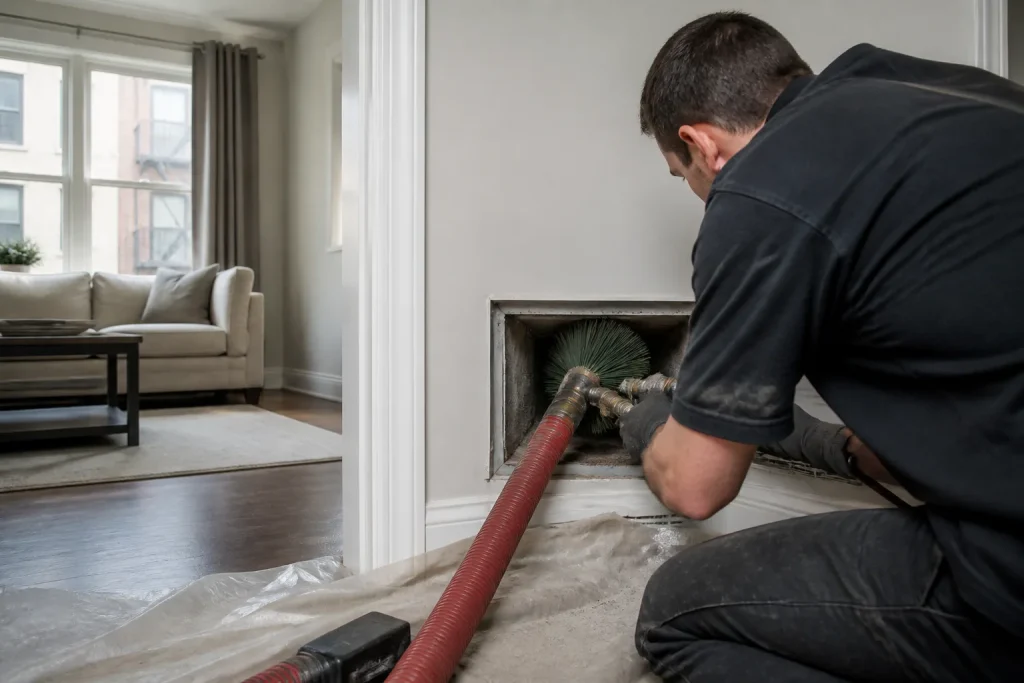
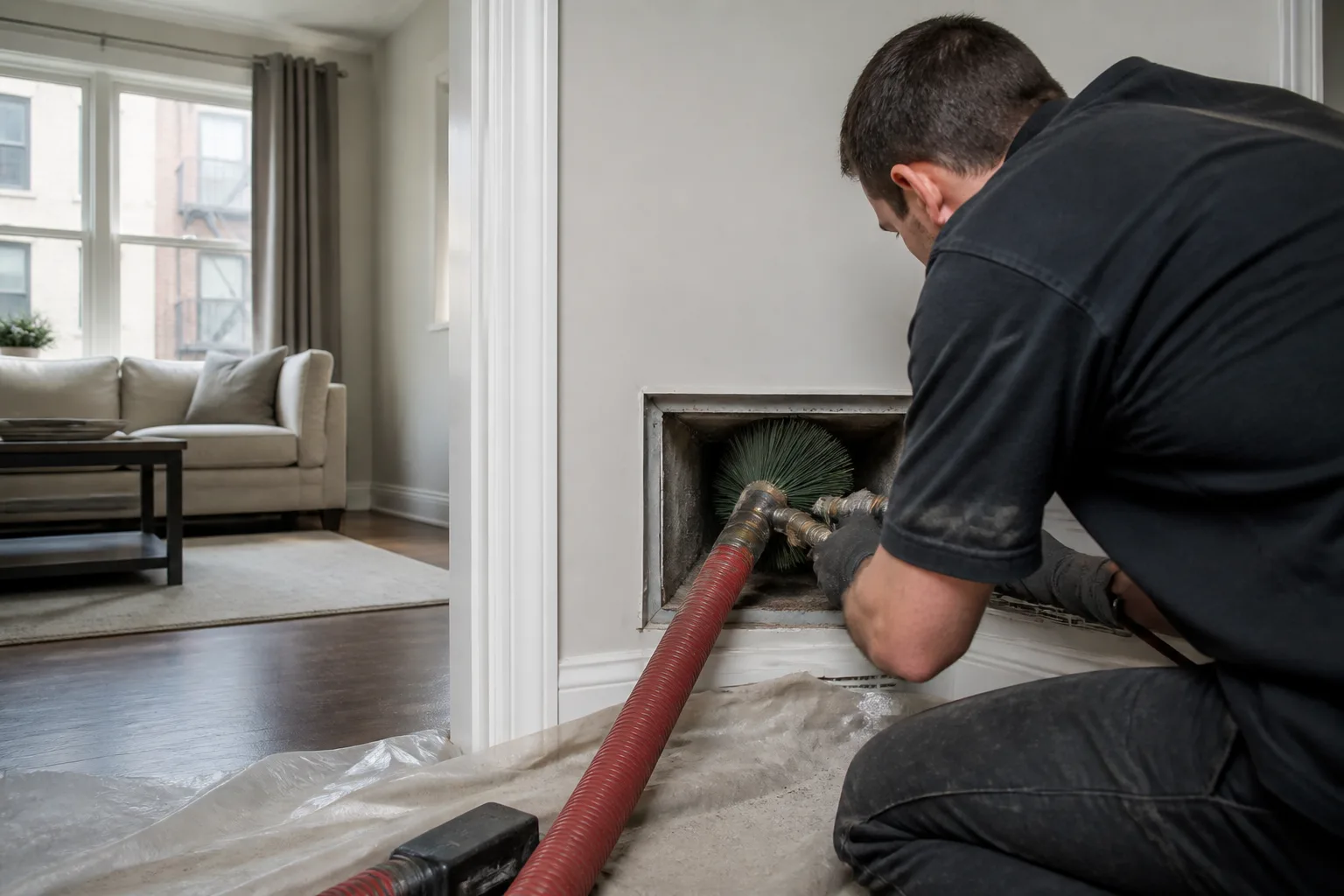
But here’s what “emergency duct cleaning” actually requires mechanically. A proper negative-pressure cleaning, where the entire system is placed under vacuum and each duct run is agitated and extracted individually, takes 3 to 6 hours minimum in a typical New York City apartment or home. That’s not padding the clock; it’s physics. Every register gets sealed, every run gets worked, the main trunk line gets opened. Any company promising a full system cleaning in 90 minutes for a crisis fee is not performing real work. They’re running a shop vac into a few registers and handing you noise for money.
In our experience, when a New Yorker has a genuine debris blow-out, the honest first step is often a temporary fix (sealing off the affected registers, running the fan in filter-only mode if the system allows) until a proper cleaning can be scheduled with correct equipment, written pricing, and a documented photo record. The equipment matters. We run Rotobrush, Nikro, and Guardsman gear because these are the brands that generate the negative pressure needed to pull debris out of a 40-foot run in a pre-war chase. A homeowner can look those models up before agreeing to a price.
What to Document BEFORE Any Contractor Arrives
This is the step most homeowners skip, and in New York City it’s the one that can save you real money. Before you call anyone, before you take photos, do these three things:
- Photograph every register vent in the unit. Close-ups of the grille, the visible interior, and any debris on the floor or furniture below. These photos become the baseline evidence that tells a contractor what they’re walking into and protects you if a building’s management disputes that the debris came from the ductwork.
- Check and photograph the HVAC filter. If it’s black, caked, or collapsing inward, that’s not just a filter problem. It tells you your system has been running with poor airflow for months, and the debris may be concentrated in the blower cabinet and evaporator coil rather than the duct runs. A filter photo also gives a technician data before they even arrive.
- Document any visible mold, staining, or moisture around registers or ceiling tiles. In New York City, water and steam riser leaks are common. If the staining is around a riser penetration, your issue may be a plumbing or building-envelope problem, and your building’s management may bear responsibility for the repair. Photos with timestamps matter.
This documentation affects the price you’ll pay and the liability picture. If you’re renting, the evidence changes who writes the check.
When the Building Owner Pays: NYC Housing Maintenance Code Section 27-2011
Here’s something few homeowners and even fewer renters know: in New York City, the legal responsibility for certain duct and ventilation issues sits with the building owner, not the tenant. NYC Housing Maintenance Code Section 27-2011 requires owners to maintain the dwelling and common areas in good repair. Ventilation systems that serve more than one unit, shared risers, shaftways, and common area HVAC equipment are typically building-owner responsibilities.
The practical translation: if you’re in a co-op or condo and your unit’s exhaust duct connects to a shared riser that’s never been cleaned, or if the debris in your system originated in a common chase, or if your bathroom exhaust doesn’t pull because the roof fan is dead, the cost may belong to the building. If you’re a renter and your landlord has ignored documented requests to clean or repair a ventilation system, Section 27-2011 gives you legal standing, and a written record (photos, emails, a technician’s findings) strengthens an HP action in Housing Court.
This is another reason the documentation step matters before you call any contractor. A written scope and photo record from a competent duct contractor can be the difference between a building management saying “that’s your problem” and a legal obligation being enforced.
The After-Hours Vetting Script: Three Questions Before You Give an Address
When you’re calling someone at night or on a weekend, the pressure to just book something is real. Push back with these three questions. Every one of them screens out the shop-vac crews.
- “Will I receive a written price and scope of work before any equipment comes off the truck?” If the answer is anything but yes, hang up. Under our operating standard, Haven Standard Clause 1, a written price is delivered before any work starts, every single time. We’ve done this since our first job in 2013, and “call for a quote” doesn’t exist in how we operate. A contractor who won’t put a price in writing before starting is planning to add costs after the fact.
- “Will I receive a photographed record of the inside of my duct runs, before and after the work?” If the answer is anything but yes, hang up. Photographic documentation is the only way to verify that work actually happened inside the ductwork. We included a documented photo record on our first job in 2013, and it’s been standard on all 52,000+ homes we’ve served since. A contractor who won’t photograph the work doesn’t want you to see it.
- “What equipment are you running, and can I look it up before you arrive?” If they can’t name a trade-recognized brand, or they mumble, that’s your answer. Equipment specificity is the difference between professional-grade negative-pressure extraction and a glorified carpet cleaner. We name our equipment, Rotobrush, Nikro, Guardsman, Honeywell, because we want customers to know what we’re using before we arrive.
When we answer the phone at (806) 606-6902, even at 2 a.m., a live person answers. You’ll get direct answers to all three of those questions without a pause.
Related Services in New York City
If this triage leads you to the conclusion that duct cleaning is the right next step, we offer air duct cleaning in New York City as our core service. If the issue is your clothes dryer, a dryer vent cleaning in New York City is a different service with a different set of variables, and a clogged dryer vent is one of the few genuinely urgent issues in this category because it’s a fire risk. If your system needs a more comprehensive inspection, our HVAC cleaning in New York City service covers blower cabinets, coils, and air handlers.
One more thing worth saying plainly. The duct cleaning industry in New York City is full of $79 coupons that turn into $900 invoices. We don’t play that game. Every job starts with a written price, every duct run is photographed before and after, and our 365-Day Done Right Promise means that if the work isn’t right, we make it right. In writing, on every job, not as a marketing line. It’s how we’ve operated since 2013, and it’s why we’re still here.
What happens when you call
- 1
A real person answersNo phone trees - you reach a local pro.
- 2
You get an upfront price rangeHonest numbers before anyone is dispatched.
- 3
A background-checked tech heads outLicensed & insured, dispatched right away.
- 4
You approve before work beginsNothing starts until you say go.
The Bottom Line
Here’s what to remember when the 10 p.m. “emergency” hits.
- Visible smoke or a CO alarm means 911 or Con Ed first, never a duct cleaner.
- Musty, sewage, or decomposition odors are HVAC or pest problems first, duct cleaning second or third.
- Visible debris blow-out is a true duct emergency, but a real cleaning still takes 3 to 6 hours. Anyone promising 90 minutes is not doing the job.
- Document everything with photos before you call anyone. It affects price, liability, and your legal position under NYC Housing Maintenance Code Section 27-2011.
- Ask every contractor three questions before you give an address: written price before work starts, photo documentation of the duct runs, and equipment you can look up independently.
If you’re in New York City and need help working through this, CleanRun Air Duct Cleaning offers a free second opinion on any written estimate and answers every call with a live person. Call (806) 606-6902.
Frequently Asked Questions
A burning smell from the vents at the start of the heating season is usually months of dust burning off the heat exchanger, and it clears within a few hours. If the smell persists, is accompanied by visible smoke, or your CO alarm sounds, call 911 or Con Ed immediately, then have an HVAC technician inspect the heat exchanger. Duct cleaning is rarely the correct first response to a burning smell in New York City homes.
No. A duct cleaning company can remove debris and sanitize after a pest issue is resolved, but the first call should be pest control to eliminate the animals and building management to seal the entry point. In New York City co-ops and multi-unit buildings, structural exclusion work is almost always the building owner’s responsibility. Cleaning ducts first without fixing the entry point means the problem returns. Call (806) 606-6902 after pest control has done their part, and we’ll handle the decontamination with written pricing and photo documentation.
Companies that advertise very low prices, like $79 whole-house specials, are typically running a bait-and-switch. The low price gets a truck in the driveway, and the invoice grows once panels start coming off. A legitimate whole-system cleaning in New York City, with negative-pressure equipment, proper agitation of every duct run, and photo documentation, costs several hundred dollars for a typical home; that’s the honest range. We put our price in writing before any work starts, every time, under Haven Standard Clause 1. No call-for-a-quote, no post-arrival surprises. Call (806) 606-6902 for an exact number, in writing, before anyone touches your system.
The only reliable way is photographic documentation from inside the duct runs, before and after. If a contractor won’t provide that, assume the work does not exist. At CleanRun, we’ve photographed the inside of every duct run on every single job since our first one in 2013. Over 52,000 homes served, every one with a photo record the customer receives when the crew leaves. If there’s no photo, there’s no proof. That’s how you verify the work, and it’s included as a standard deliverable when you call (806) 606-6902.
Written by Tomas Reyes, Owner at CleanRun Air Duct Cleaning, serving New York City since 2013.
Need Air Duct Cleaning Help?
Call CleanRun Air Duct Cleaning - licensed & insured, here with fast after-hours help in Burbank.
(806) 606-6902