
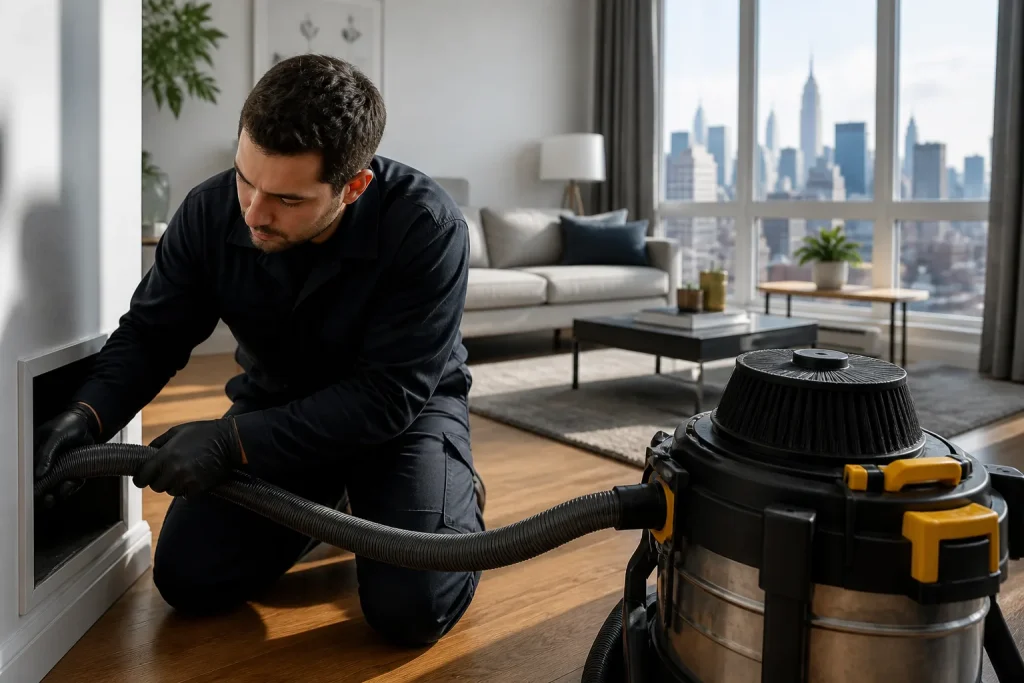
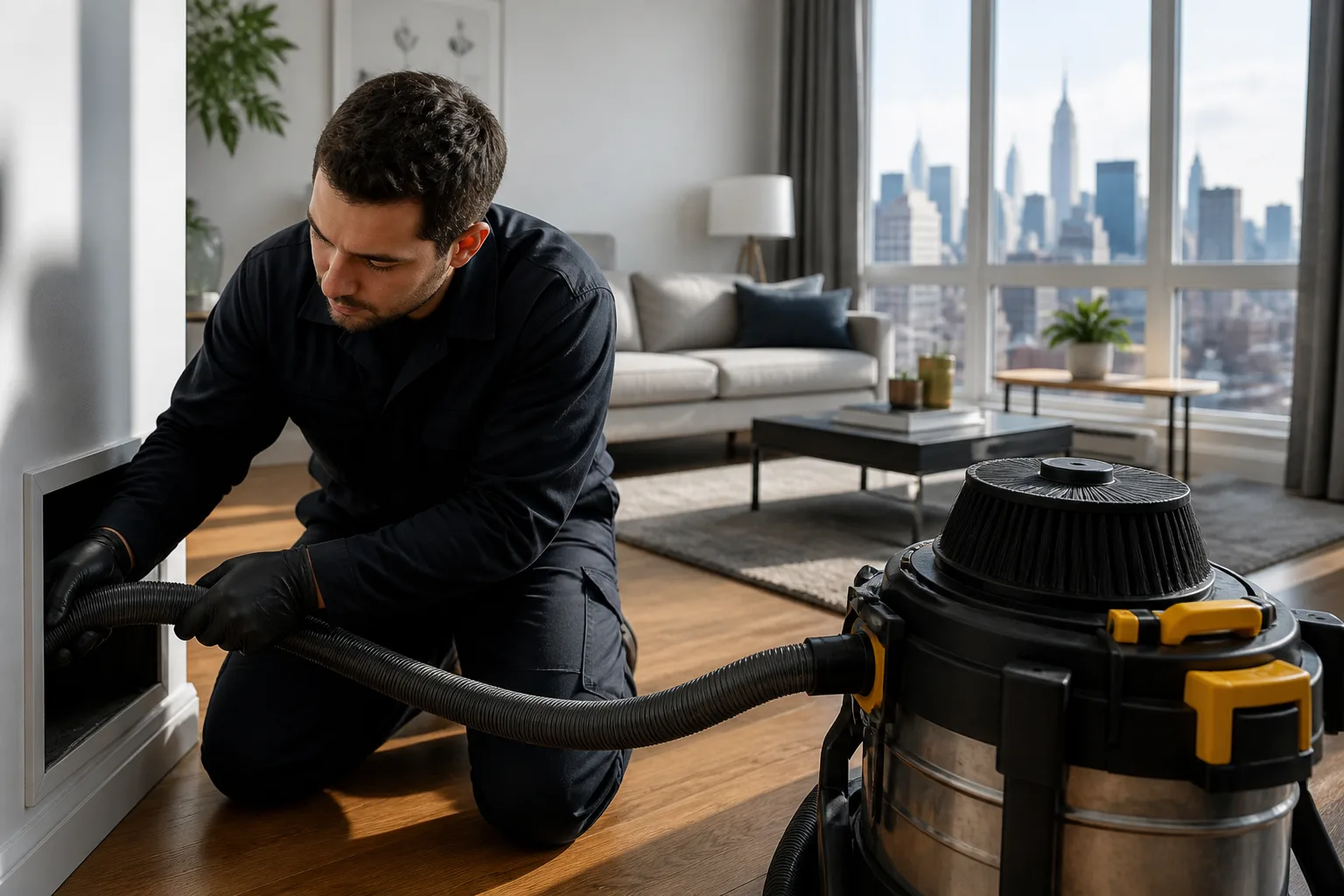
Air Duct Cleaning What It Really Costs: What New York City Homeowners Pay in 2026
A legitimate, documented air duct cleaning in New York City costs between $450 and $1,100 for a typical apartment or townhouse system in 2026, with larger multi-zone high-rise units running $1,200 to $2,400. Anything under $200 is almost certainly a bait-and-switch that sells you a visit, not a cleaning. If you’d rather not spend the next 20 minutes learning how to read an invoice, call CleanRun Air Duct Cleaning home at (806) 606-6902 and we’ll walk you through a written quote.
Here’s the problem in a single story. A Manhattan homeowner paid $129 for an air duct cleaning last spring. A crew ran a shop vac for 40 minutes, handed over a one-page receipt with no measurements, and left. Three months later, a second company photographed 11 pounds of compacted debris still sitting inside the return plenum. The $129 job wasn’t cheap. It was unpaid labor for the second contractor who had to do the actual work.
In New York City, where a studio apartment costs more than a four-bedroom house in most of the country, the duct cleaning industry has evolved into two distinct businesses. One sells a documented service at a price you can verify. The other sells a phone number and a surprise. This guide breaks down the real numbers by line item so you can read any quote and know which one you’re holding.
What Air Duct Cleaning Actually Costs in New York City in 2026
We publish our price structure because Haven Standard Clause 1 says a written price comes before any work starts, on every job. Most New York City homeowners pay within these ranges for a complete cleaning of all supply ducts, return ducts, the main plenum, and the blower cabinet:
| Job Type | Typical NYC Price Range 2026 | What It Includes |
|---|---|---|
| Studio or 1-bedroom apartment (up to 6 duct runs) | $450 - $650 | Full negative-pressure extraction, all registers, return plenum, blower cabinet, photo record |
| 2-3 bedroom apartment or condo (8-14 duct runs) | $650 - $950 | Full system cleaning, sanitizing optional, access panel coordination where needed |
| Large pre-war apartment or single-family Brooklyn/Queens home (15-25 duct runs) | $950 - $1,400 | Full system, multiple access points, longer labor for older sheet-metal ductwork with elbows |
| Multi-zone high-rise unit or townhouse with complex duct routing | $1,200 - $2,400 | Elevator coordination, building superintendent scheduling, multiple access panels, full photo documentation |
| Dryer vent cleaning (add-on or standalone) | $150 - $350 | Full run from dryer to exterior termination, before/after photos, airflow verification |
These are whole-system prices, not per-vent teaser rates. A quote that prices “per vent” is engineered to be low on the phone and high on the invoice. We’ll get to that.
Relevant: Air Duct Cleaning in New York City explains our standard scope in detail.
Why Some Quotes Are $79 and Others Are $2,400: The Line-Item Breakdown
The $79 coupon and the $2,400 invoice are both real numbers from the same industry. The difference is what each contractor plans to do once they’re standing in your living room.
A legitimate New York City duct cleaning invoice should read like this:
- Setup and equipment staging: $50 - $150. This covers the HEPA-filtered negative-air machine, the Rotobrush or Nikro agitation tools, and protective floor coverings. Real equipment costs money to move and set up correctly.
- Per duct run, negative-pressure cleaning: $35 - $65 per run, not per vent. A “run” is the section of ductwork between the main trunk line and a register. Average NYC apartments have 6 to 14 runs depending on size. This is where a per-run quote is honest and a per-vent quote is a shell game: one run typically serves one to three vents, so the guy quoting “$30 per vent” for 30 vents is charging $900 for the same work the per-run guy prices at $420.
- Return plenum and main trunk line: $150 - $350. This is the big box where debris accumulates. In NYC, return plenums in pre-war buildings often haven’t been opened since installation. We’ve documented 3-inch debris build-up at the first elbow in units from the Upper West Side to Astoria.
- Blower cabinet and evaporator coil inspection: $100 - $250. If the blower is caked in dust, the cleaning didn’t work. This should always be inspected and photographed.
- Access panel creation: $75 - $200 per panel. Many NYC systems, especially in older buildings, lack proper access points. A real technician will cut and seal a proper access panel. A $79 crew will skip this step entirely and clean only what they can reach from the register, which is almost nothing.
- Sanitizing / deodorizing: $75 - $250. We use EPA-registered products from brands like Honeywell and Guardsman. This is worth paying for if there’s documented mold or persistent odor, but it’s the most commonly oversold add-on in the industry. A legitimate contractor will show you the photo evidence before recommending it, not add it to the invoice uninvited.
Now read a bait-and-switch quote:
- “Duct cleaning: $79” (No scope, no run count, no time estimate.)
- “Sanitizing: $199” (Necessary? Maybe not. They won’t show you why.)
- “Mold treatment: $899” (They found “mold” but no lab result, no photo, no remediation protocol.)
- “Deodorizing: $149” (The same fogger from the sanitizing step, itemized twice.)
- “Access panel: $350” (Now they admit they need one; it was never included.)
The total arrives mid-job, while the machine is running and the technician is explaining that “this is more buildup than we expected.” The price was never $79. It was a deposit for a sales call.
The New York City Cost Drivers No One Else Mentions
Cleaning ductwork in a Greenwich Village brownstone is not the same job as cleaning it in a cul-de-sac in Ohio. Three factors make NYC uniquely expensive, and none of them appear on a national pricing chart.
Elevator fees and building superintendent coordination. High-rise buildings charge contractors for elevator time, sometimes $50 to $150 per trip. Many also require a certificate of insurance on file with the management office and scheduling windows that conflict with anything resembling a normal workday. A co-op board in Murray Hill can add two hours of paid labor just in logistics. A contractor who quotes you $199 for a high-rise job is either not planning to actually bring equipment upstairs or is going to “discover” a coordination fee at the door.
Pre-war asbestos wrap. Buildings constructed before the 1980s often have asbestos insulation on duct joints and elbows. Any legitimate company in New York City will pause the moment they see suspect material and recommend testing before proceeding. That testing costs $200 to $500 and adds a week to the timeline. The $79 crew will either ignore it, which is dangerous, or use it as a mid-job upsell, which is also dangerous. A written quote from a responsible contractor will state upfront that if suspect material is encountered, work pauses and testing is required. That sentence alone filters out most bait-and-switch operators.
Truck parking and labor costs. Parking a box truck in Park Slope or the Financial District costs real money in 2026, either through meters, commercial parking zones, or the time spent circling for a legal spot. That’s labor. Someone is paying for it, and it’s either baked into an honest quote or hidden in a “travel surcharge” on a dishonest one.
We’ve pulled enough debris out of enough New York City ductwork to know that a pre-war building in Washington Heights has almost nothing in common with a new construction tower in Long Island City. The quote should reflect the building, not a national average.
Flex Duct vs. Sheet Metal: Why the Material Matters for Your Budget
The type of ductwork in your building directly affects the labor hours and the price. New York City’s housing stock spans 100-plus years, so a single block can contain both materials.
Sheet metal ductwork is common in pre-war and mid-century buildings. It’s rigid, durable, and generally cleanable with standard agitation tools and negative-pressure extraction. But it has elbows, transitions, and seams where debris piles up. It also rusts. A sheet metal system that hasn’t been cleaned in two decades is not invisible debris, it’s debris that has adhered to the metal. That takes longer to clean properly, and “properly” is the word you’re paying for.
Flex duct is white plastic over wire coil, common in newer construction and renovations. It’s cheaper to install and easier to damage. Aggressive agitation tools tear the liner. A legitimate company uses different techniques for flex, typically lower-pressure agitation and longer extraction time. That labor shows up as more hours, not more per-vent pricing.
The cost difference is rarely more than $100 to $200 for an average system, but it’s a question you should ask before the crew arrives: “Do you know what kind of ductwork I have, and does it change your approach?” If the answer is “ducts are ducts,” the quote isn’t serious.
We run Nikro and Rotobrush extraction equipment with attachments specific to each material. The tool matters less than knowing when not to use it.
How to Read a Written Quote Before You Sign It
New York City has a robust housing market and a correspondingly robust population of contractors who rely on vague language. Here is what a legitimate fixed-price quote must contain:
- Total number of duct runs, specifically counted. Not “up to” and not “typical.” The quote should say “14 duct runs” because the contractor visited or requested your building’s mechanical plan.
- Total price, in dollars, for the entire scope. No “starting at.” No “based on condition.” A fixed price is a fixed price. If the tech discovers a real issue mid-job, that’s a change order with a separate written approval, not a surprise on the final bill.
- Equipment to be used, by name. “Professional-grade equipment” means nothing. “Nikro HEPA-Filtered Negative Air Machine, Model X” means something. You should be able to look up the tool and verify it’s the right class of equipment.
- What happens with suspect asbestos. The quote should say that work pauses, testing is recommended, and the contractor will not proceed through suspect material. Absence of this clause in a pre-war building is a red flag.
- Documentation deliverable. The quote should state that you will receive before-and-after photographs of the inside of every duct run. If it doesn’t say that, you are buying trust, not evidence.
- Warranty language. Specific: “If any cleaned duct is found obstructed within 365 days, we re-clean at no charge.” Vague: “Satisfaction guaranteed.”
We deliver a Documented Photo Record on every visit, a practice we’ve held since our first job in 2013. The camera goes inside the duct. You see what the machine saw. That’s the difference between a service and a story.
Related: HVAC Cleaning in New York City covers the blower cabinet and coil side of the system.
Cleaning Frequency: What It Costs to Stay Ahead vs. Catch Up
Most New York City systems need cleaning every three to five years, not every year. The “annual duct cleaning” pitch is largely invented by the same industry that brought us the $79 coupon. But the other extreme, never cleaning at all, has a cost too.
Let’s do the math on a typical two-bedroom Queens co-op:
- Cleaning every three years with documentation: $750 per cleaning, or $250 per year amortized. The system stays clear, the photos prove it, and any developing issue is caught before it becomes an HVAC repair bill.
- Reacting to visible mold or reduced airflow after 15 years: $750 to $2,400 for the cleaning, plus $400 to $900 for coil cleaning if the blower has been recirculating debris, plus the cost of treating the specific problem. In a NYC apartment where the HVAC is often embedded in a wall or closet, that’s not a maintenance bill. It’s a renovation.
The cost comparison isn’t even close, but the more interesting number is what the three-year cycle buys you: a documented record of the system’s condition over time. When you sell the apartment, you can show the buyer a photo record of the ducts being maintained. In a market where buyers scrutinize every line of a co-op financial statement, that’s a small document that reads like diligence.
If you have a dryer vent that hasn’t been looked at in years, Dryer Vent Cleaning in New York City is the more urgent appointment. Clogged dryer vents are a leading cause of residential fires, and the vent is usually far shorter and cheaper to clean than the duct system.
When to Call a Pro
Duct cleaning is not a DIY project, and it’s not even a “handyman with a shop vac” project. Proper cleaning requires negative-pressure extraction equipment that puts the system under vacuum while agitation tools knock debris loose. A shop vac pushes air around a register. A real system pulls air through the entire duct run and filters it through HEPA before it returns to your living space.
Call a professional when any of these are true:
- You’ve never cleaned the ducts and the building is over 10 years old.
- You can see dust puffing from registers when the system starts.
- A family member has unexplained allergy symptoms that improve when the HVAC is off.
- You’re buying or selling and want documentation of the system’s condition.
- The previous cleaning produced no photos, no measurements, and no evidence beyond a receipt.
Tomas Reyes started CleanRun in 2013 after spending too many afternoons re-cleaning systems that other companies had supposedly cleaned the week before. The pattern was always the same: a low price, a quick visit, no camera, no record. He built the company around the idea that documentation is the product.
We pulled a 9-pound clump of construction debris, drywall chunks, and the previous renovator’s paint roller out of a return plenum in a Cobble Hill brownstone last fall. The homeowner had paid a “cleaning service” six months earlier. The receipt was for $149. The roller was still in the duct.
The Bottom Line
Air duct cleaning in New York City costs between $450 and $1,400 for most homes in 2026. The honest quotes are itemized by duct run, include access panel work where needed, and come with a written fixed price and a photo record. The dishonest ones quote per vent, start at a number no one will ever pay, and discover “extras” once the truck is unloaded.
Ask for the run count. Ask for the brand of equipment. Ask what happens if they find asbestos in a pre-war building. If the answer to any of those is vague, the price is too.
If you’re in New York City and want a documented picture of what’s actually inside your ductwork, CleanRun Air Duct Cleaning delivers a written price before any work starts and a photo record when the crew leaves. Call (806) 606-6902 for a free estimate.
Frequently Asked Questions
A legitimate full-system duct cleaning in New York City costs $450 to $1,400 for most apartments and homes, depending on the number of duct runs, building access, and duct material. High-rise units with complex systems can reach $2,400. Prices below $200 should be treated as a sales visit, not a cleaning. Call (806) 606-6902 for a written quote specific to your building.
Cheaper quotes usually price per vent rather than per duct run, exclude access panel creation, and omit the return plenum and blower cabinet from the scope. The low price gets the crew in the door. The real total arrives mid-job as a series of required add-ons. Honest quotes itemize the full system upfront.
Require before-and-after photographs of the inside of every duct run. Any legitimate company in New York City can provide this, either with a push camera or by documenting the extraction process. If the only deliverable is a receipt, you paid for a visit, not a cleaning. CleanRun includes a Documented Photo Record on every job as a standard deliverable.
Every three to five years for most systems, not annually. Buildings near construction, homes with pets, and units occupied by smokers or allergy sufferers may need more frequent service. The best indicator is photographic evidence of debris build-up inside the return plenum, which is worth checking every few years regardless of schedule.
Written by Tomas Reyes, Owner at CleanRun Air Duct Cleaning, serving New York City since 2013.
Need Air Duct Cleaning Help?
Call CleanRun Air Duct Cleaning - licensed & insured, here with fast after-hours help in Burbank.
(806) 606-6902