
Honeywell Air Duct Cleaning in New York City: A Homeowner’s Guide
Honeywell does not clean air ducts. The company manufactures thermostats, media filters, UV lamps, and ventilation controls - but no Honeywell-branded crew will arrive at your building with negative-pressure extraction equipment. When New York City homeowners search “Honeywell air duct cleaning,” what they’re actually looking for is a contractor who understands the Honeywell components already installed in their HVAC system, and that search should lead you to a documented cleaning job, not a brand affiliation that does not exist.
If you’d rather skip the research and speak directly with a New York City contractor about your system, call (806) 606-6902. Now, here’s what every homeowner in the five boroughs should know before hiring anyone for the job.
Key Takeaways
- Honeywell manufactures components (filters, controls, UV systems) - it does not operate or certify duct cleaning services.
- Any contractor claiming a “Honeywell certification” for duct cleaning is stretching the truth; no such credential exists.
- A proper cleaning on a New York City system with Honeywell media filtration runs roughly $450-$850, depending on the number of duct runs and whether UV lamps or ERVs are present.
- Before-and-after photo documentation of every duct run is the single best way to verify the work was actually performed.
- Written pricing before work starts is non-negotiable in this industry; the bait-and-switch model is alive and well in NYC.
What Honeywell Actually Sells vs. What You’re Searching For
Honeywell’s HVAC division produces controls and air quality components: programmable thermostats, electronic air cleaners, media filter cabinets, UV surface treatment lamps, humidistats, and residential ventilation controls. None of those products clean ductwork. The confusion starts because homeowners see the Honeywell logo on their thermostat or filter housing, then search for someone to clean the system that contains those parts - and the search phrase becomes “Honeywell air duct cleaning” rather than “air duct cleaning in New York City.”
Here’s the practical distinction. A Honeywell F100 media filter cabinet sits at the return side of your air handler and holds a 4-inch pleated filter that captures particles before they reach the blower. It needs regular filter replacement - the filter itself, typically every 6 to 12 months depending on building conditions - but the filter cabinet does not clean the return trunk, the supply plenum, or the duct runs that move air through your apartment or brownstone. Those surfaces still collect construction dust, sheetrock residue, pet dander, and cooking grease, especially in pre-war buildings where ductwork has been in place since the building went up.
In New York City, we’re dealing with duct systems squeezed into chases, soffits, and tight mechanical closets. The Honeywell badge on the filter door doesn’t change what’s inside the duct run. A 12-inch flex run in a Chelsea loft with a new Honeywell thermostat accumulates the same fine dust as one in a Forest Hills co-op with an old round dial - the difference is what you ask the cleaner to do about it, and what they document.
How Honeywell Components Interact with Ductwork - and What a Cleaner Should Do Around Them
When CleanRun Air Duct Cleaning home technicians encounter a system with Honeywell equipment in a New York City building, the first step is identifying what’s installed and what it means for the cleaning plan. This matters because certain components should be removed, protected, or bypassed during aggressive cleaning, and a contractor who ignores them can void warranties or damage sensitive parts.
Here’s what we look for on a typical Manhattan or Brooklyn job:
- Honeywell media filter cabinet: The filter is removed before cleaning begins. The cabinet itself is wiped down and vacuumed separately; the blower side should be sealed off during negative-pressure extraction so loosened debris doesn’t get pulled into the motor.
- Honeywell UV lamps: UV bulbs sit inside the supply plenum or above the coil. The bulbs must be off for at least 15-20 minutes before work starts (they run hot), and they should be removed or carefully covered if the plenum is being brushed. UV lamps are glass; a broken bulb in a duct run is a problem no homeowner wants to discover.
- Honeywell ERV or ventilation control: If the building has an energy recovery ventilator wired to a Honeywell control, the cleaner needs to know how the airflow is balanced. Closing off one side without understanding the system can pressurize the ducting and push debris somewhere you don’t want it.
- Aprilaire humidifiers or filters: Some New York City systems mix brands. An Aprilaire humidifier mounted on the return plenum needs its bypass damper in the right position during cleaning, and its water panel should be evaluated separately.
The point is not that Honeywell equipment makes cleaning dangerous. It’s that the equipment changes the procedure, and a documented cleaning job includes notes on what was removed, what was protected, and what was photographed before and after.
Honeywell “Certification”: What It Would Mean and Why It Doesn’t Exist
Honeywell does not certify duct cleaning companies. It certifies distributors and technicians for specific product lines - controls installation, thermostat programming, and some commercial building management systems - but there is no Honeywell duct cleaning credential. Any contractor in New York City who advertises “Honeywell-certified duct cleaning” is either confusing the homeowner deliberately or has not thought carefully about what the phrase means.
Before you schedule a cleaning, ask these four questions:
- “Can you show me the written certificate?” If it doesn’t exist, the claim doesn’t either. Honeywell’s technician certifications are product-specific and have nothing to do with duct brushes or vacuums.
- “What equipment will you use, by brand name?” The answer tells you if the contractor uses professional-grade tools. We run Rotobrush and Nikro negative-pressure systems, and we name them on the job summary you receive.
- “What will I see when you’re done?” The right answer includes photos of the inside of your duct runs, before and after, delivered to you as part of the standard job record. If a company can’t show you what the duct looked like before, they can’t prove what they changed.
- “Will the price be in writing before you start?” If the answer is a hedge, hang up. A written price before any work begins - no exceptions - is the floor for a credible contractor, not a selling point.
We pulled a 1998-era Honeywell electronic air cleaner out of a Park Slope brownstone last month. The owner had been told it was handling the dust problem. The camera feed showed a 3-inch debris build-up at the first elbow of the return drop, and the air cleaner’s collection cells were so caked they weren’t collecting anything. The brand name was fine; the maintenance story wasn’t.
What a Documented Cleaning Job Looks Like in a Honeywell-Equipped Home
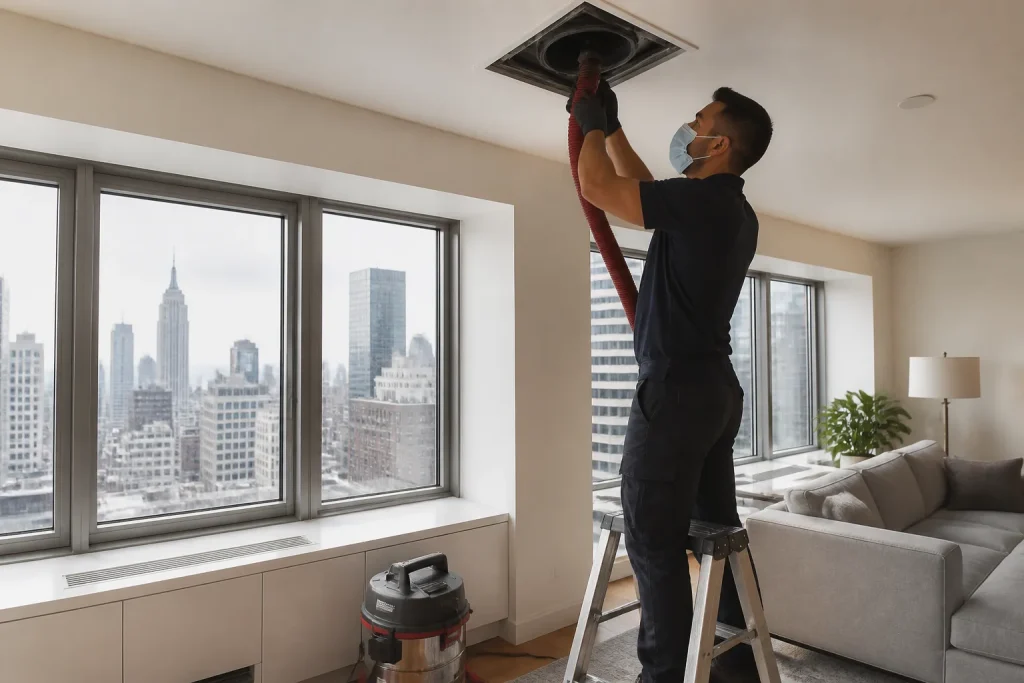
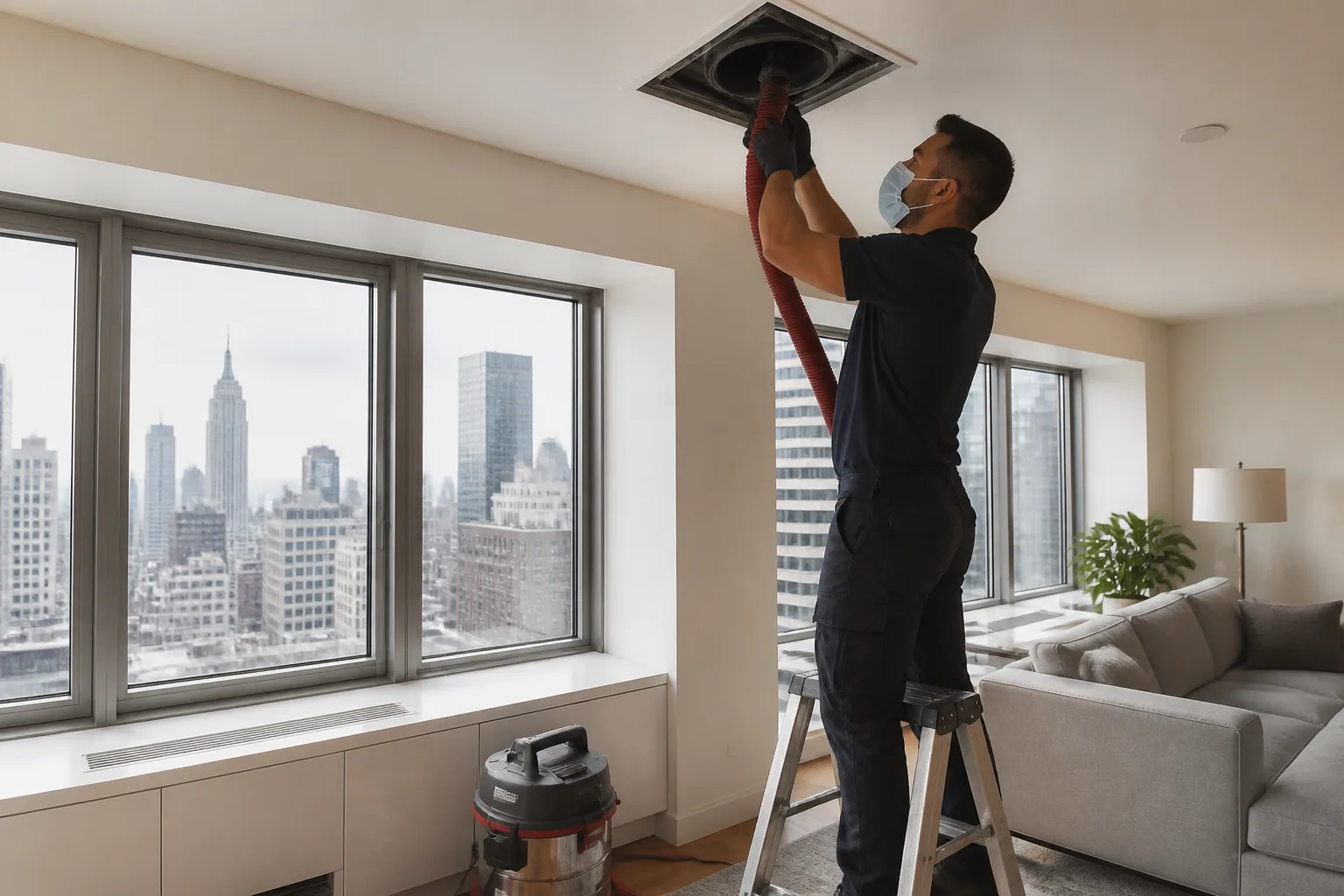
You’ll know the work was done because you can see it. Here’s the sequence a proper Air Duct Cleaning in New York City job follows when Honeywell filtration or controls are in place:
- System inspection: The technician locates the blower, coil, plenums, and all accessible duct runs. Filter conditions are noted, and the Honeywell components (filter cabinet, UV lamps, sensors) are identified and photographed.
- Written scope and price: Before any panel comes off, you see the line items: number of supply runs, number of returns, the main trunk length, and any add-ons such as UV lamp service or coil cleaning. One flat price, in writing.
- Containment and negative pressure: The system is placed under negative pressure using a professional-grade vacuum - commonly a Nikro or Rotobrush unit - so debris loosened during brushing is pulled out of the ductwork, not pushed into the living space.
- Mechanical agitation: Each duct run is agitated with rotating brushes or air whips. The camera records the condition before and after each run. Here’s where a Honeywell filter cabinet gets special attention: the housing is cleaned separately, and the filter slot is wiped down so a replacement filter seats correctly.
- Component handling: UV lamps are removed or protected, and checked for replacement if the owner asks. The media filter is swapped only if you’ve requested it - and you’ll see the date written on the new filter in the photo record.
- Final documentation: You receive a digital photo record of every duct run, inside, before and after. This is the standard deliverable - not an upsell - because if it can’t be photographed, it didn’t happen.
For New York City homeowners in a condo or co-op, keep in mind that your board may require proof of maintenance. The photo record we provide has served as that proof more times than we can count.
Realistic Pricing for Duct Cleaning with Honeywell Equipment in NYC
New York City pricing is higher than the national average for the same reason your rent is higher: building access, parking, freight-elevator restrictions, and labor costs all show up on the invoice. Here’s what we’ve seen across the five boroughs on systems with Honeywell media filtration or controls:
- Standard forced-air apartment (2-3 bedrooms, 8-12 duct runs): $450-$650 for the cleaning, with the photo record included as standard.
- Larger brownstone or townhouse system (12-20 runs, multiple returns): $650-$850, depending on the number of flex runs and the condition of the main trunk.
- Add-on: UV lamp inspection or replacement: $35-$60 for inspection; replacement bulbs are a separate line item you’ll see before work starts. Honeywell UV lamps are proprietary sizes - the contractor should verify the model before quoting.
- Add-on: media filter replacement: $45-$85 depending on the filter size and MERV rating. We’ll show you the old filter and the new filter in the photo record.
Be wary of quotes below $300 for a full system in New York City. At that price, the company is either not cleaning the full ductwork or planning to make up the difference with “discovered” problems once the van is parked outside. One flat price per system, agreed before work starts, is the protection against this - and it’s a promise that should appear in the written scope, not just the estimate. When a homeowner brings us a competitor’s written estimate, we provide a free second opinion and put our number next to it, in writing.
When to Call a Pro Instead of Going It Alone
If your system includes Honeywell UV lamps, an ERV, or a media filter cabinet that hasn’t been opened in years, call a professional. These are not vacuum-the-vent jobs. The UV lamp sits in the supply plenum and runs at high temperature; the ERV has core membranes and balance settings; the filter cabinet has a sealing gasket that compresses when the door closes. A homeowner with a shop vac can reach the first six inches of the register, but they cannot clean the duct run - and they cannot see what’s actually inside it.
If you’re reading this and thinking, “I just want someone to show me what’s in my ducts and clean it properly,” that’s the service we provide. HVAC Cleaning in New York City covers the coil, blower, and plenums as part of the same documented visit. And if your building has a dryer exhaust, Dryer Vent Cleaning in New York City is often the more urgent job - lint-clogged dryer vents cause far more building fires than dusty supply registers.
The Bottom Line
Honeywell makes excellent air quality components, and a New York City home with Honeywell filtration or controls deserves a cleaning contractor who understands what those components do and how to work around them. But the brand name is not a cleaning service, and no “Honeywell certification” for duct cleaning exists. What protects you as a homeowner is more concrete: a written price before any work begins, a photo record of every duct run before and after, and a contractor who names their equipment so you can verify it independently.
If you’re in New York City and need help with your system, CleanRun Air Duct Cleaning offers free estimates. Call (806) 606-6902 and we’ll walk your system, show you the photo record process, and give you a written price before a single panel comes off.
Frequently Asked Questions
No. Honeywell manufactures thermostats, filters, UV lamps, and ventilation controls, but the company does not operate duct cleaning crews or franchise any cleaning services. A New York City contractor who says they’re “Honeywell-certified” for duct cleaning is misrepresenting what Honeywell actually certifies.
Most New York City apartments and brownstones with Honeywell filtration run between $450 and $850 for a full cleaning, depending on the number of duct runs and whether UV lamps, ERVs, or media filter cabinets require handling. A written price before work starts should be standard; if it isn’t, find another contractor. Call (806) 606-6902 for an exact quote on your system - estimates are free.
You’ll see it. A reputable contractor photographs the inside of every duct run before and after the cleaning, and delivers those photos to you as part of the standard job record. If the company can’t show you a before photo, they can’t prove they changed anything. This is why we’ve built our entire process around a documented photo record on every visit.
It shouldn’t, provided the contractor protects the components properly. UV lamps need to be removed or covered during brushing, and media filter cabinets should be sealed off from negative-pressure extraction so debris doesn’t get pulled into the blower. A contractor who treats Honeywell components as regular duct surfaces is a risk; one who names the components they protect is a professional.
Written by Tomas Reyes, Owner at CleanRun Air Duct Cleaning, serving New York City since 2013.
Need Air Duct Cleaning Help?
Call CleanRun Air Duct Cleaning - licensed & insured, here with fast after-hours help in Burbank.
(806) 606-6902